
Rutgers-Aggregation
- Title
- Rutgers-Aggregation
Items
-
Unnamed Black woman [Freeman] (b. 1790)A Black woman, whose name has not been found in historical records, was enslaved by Alpheus Freeman. She was born in approximately 1790. After the death of Alpheus Freeman, the administrators of his estate placed an advertisement for the sale of this woman, who was aged 24 years old at this time in 1814. The ad described her as a "slave for life" and "stout, active and healthy."
-
Unnamed Black woman [Hardenbergh]A Black woman, whose name has not been found in historical records, was a cook in the Hardenbergh household in Somerville, NJ. Jacob Rutsen Hardenbergh Jr. (1768-1841) placed an advertisement for her sale in December 1800 in a New Brunswick newspaper.
-
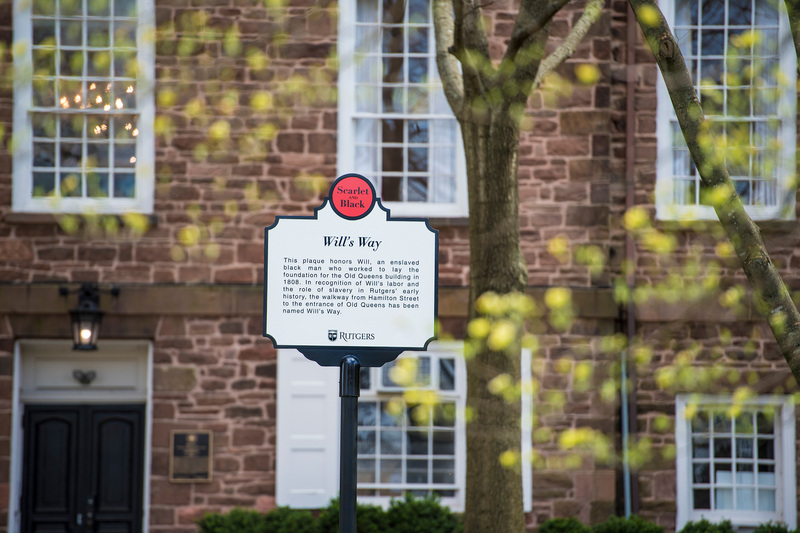 WillWill was an enslaved man who lived in New Brunswick in the early 19th century. His enslaver was Dr. Jacob Dunham, a local physician, who routinely hired out Will's labor to others in the city. Dunham collected about a dollar a day for Will's labor. Will worked doing masonry, hauling heavy loads, breaking sugar, and ringing a bell at auctions. In 1808 and 1809 he worked at the Queen's College (later Rutgers) construction site, laying the foundation and doing masonry work for the college's first permanent building. This building is known today as Old Queens, and it houses the office of the chancellor of Rutgers University–New Brunswick. The biographical facts of Will's birth, death, or other life-course events are not known. The historical record, drawn from accounting books, primarily highlights his labor. Based on the extant record of his strenuous labor, dating from the late 1800s to the early 1820s, he was probably born circa 1780s. Following the publication of Scarlet and Black, Vol. 1: Slavery and Dispossession in Rutgers History, Will was memorialized at Rutgers University. In 2017 the walkway leading up to Old Queens from Hamilton Street was named Will's Way in his honor. Two historical plaques at this location commemorate Will. The first is a large Scarlet and Black historical marker that stands on the lawn alongside Will's Way. The text reads: "This plaque honors Will, an enslaved black man who worked to lay the foundation for the Old Queens Building in 1808. In recognition of Will's labor and the role of slavery in Rutgers' early history, the walkway from Hamilton Street to the entrance of Old Queens has been named Will’s Way." The second plaque is attached to the Old Queens building by the entrance that faces Will's Way. The text reads: "The walkway leading from this door to the Hamilton Street gate has been named 'Will's Way' in recognition of the labor of an enslaved man named Will who contributed to the early development of Queen’s College, which later became Rutgers University. Construction began on Old Queen's, the college's first permanent building, in the fall of 1808. Will, who was enslaved by a local physician named Jacob Dunham, laid the foundation for the building. Dunham received about a dollar a day for Will's labor. It is likely that Will was not the only enslaved laborer on the campus of Queen’s College during its early decades, particularly in light of the fact that slavery persisted longer in New Jersey than in any northern state. This plaque and the research upon which it is based are the result of work by the Committee on Enslaved and Disenfranchised Populations in Rutgers History, formed as part of the observance of the 250th anniversary of Rutgers' founding in 2016."
-
WilliamWilliam was an enslaved man who lived in New Jersey in the early 19th century and was manumitted by Cortland L. Parker of Perth Amboy, NJ, on March 1, 1806. William was aged 21 to 40 at the time of manumission.
-
William B. ParkerWilliam B. Parker was one of the administrators of the estate of Alpheus Freeman of New Brunswick and, in this capacity, was responsible for selling an enslaved black woman after Freeman's death in 1813.
-
 William Livingston (1723-1790)William Livingston (1723-1790) was the first governor of the State of New Jersey during the Revolutionary War, serving from 1776 to 1790. In 1969, Livingston College at Rutgers University was named in his honor. His family had a long-standing connection with the university. In 1766, his brothers Philip Livingston and Robert Livingston were two of the charter trustees of Queen's College (the original name of Rutgers University); and his cousin Rev. John Henry Livingston would go on to become the university's fourth president from 1810 to 1825. William Livingston was an ex-officio member of the college's Board of Trustees (by virtue of his position as New Jersey governor), and he presided over several meetings of the board in the 1780s. Livingston came from a wealthy family of landholders, merchants, and slave-traders in New York. Before coming to New Jersey, he worked as an attorney in New York City representing the interests of his family's vast international mercantile operation; their business included slave-trading voyages to Africa and plantations in the Caribbean. He moved to Elizabeth, New Jersey, in 1772. During the American Revolution, William Livingston became convinced that slavery was incompatible with the young American nation's ideals of freedom. Livingston called slavery "an indelible blot" upon humanity. As governor of New Jersey, he opposed the slave trade and hoped to pass a gradual abolition program after the Revolution. To set a public example for other slaveholders, in 1787 Livingston manumitted a woman named Bell and her son Lambert, who had been enslaved in Livingston's household in Elizabeth, New Jersey. Livingston won a ban on the Atlantic slave trade in New Jersey in 1786 (22 years before the Atlantic slave trade became illegal nationwide). But he was not able to achieve abolition during his tenure as governor, because slaveholders who opposed Livingston's views held too much power in the New Jersey legislature. In 2021, a Scarlet and Black historical marker acknowledging the connection between the Livingston family and slavery was erected at Livingston Campus. The text of the historical marker reads thus: "Livingston Campus (site of former Livingston College) was named after William Livingston, the first governor of the state of New Jersey, whose family made a fortune trafficking human beings in the transatlantic slave trade. The campus opened in 1969 as an experimental, social-justice oriented campus at the site of Camp Kilmer, a World War II-era military camp. The Livingston family collectively enslaved hundreds of people and William’s brothers, Philip and Robert, two of Rutgers’ founding trustees, bought and sold hundreds more. When William Livingston moved to New Jersey, he enslaved at least two people, a woman named Bell and her son Lambert. Though he later advocated for gradual abolition, he continued to represent the legal interests of his slave-trading family’s wealth throughout his career. This marker honors Bell, Lambert, and the other women, men, and children enslaved and sold by the Livingston family."
-
William Philips Deare (d. 1826)William Philips Deare was a lawyer in New Brunswick, NJ. He was an alumnus of Queen's College (later Rutgers), class of 1794. He was elected a trustee of the college in 1804 and served until his death in 1826; for most of that time he was the Secretary of the Board of Trustees (1807–1821). During this period he also served as the Clerk of Common Pleas for Middlesex County and was responsible for maintaining the county records related to enslaved people's births, manumissions, and removals from New Jersey.
-
William Van Deursen (1791-1873)William Van Deursen was an enslaver who resided in New Brunswick, NJ. He was a graduate of Queen's College (now Rutgers University), class of 1809, and he served as a trustee of the college for fifty years from 1823-1873. He was a prominent local physician and was active in the New Jersey Medical Society and the Middlesex County Medical Society. His father Willem (William) Van Deursen (1736-1816) had also been one of the early trustees of Queen's College, and his older brother Staats Van Deursen was the treasurer of the college. In 1817, William Van Deursen and his brother Staats decided to sell two young Black women to a man named Jacob Klady who was moving from New Brunswick to Ouachita, Louisiana, to establish a plantation there. As the result of William Van Deursen's actions, a 22-year-old woman named Dinah was taken away from New Jersey to Louisiana to work on Klady's plantation. At the same time, his brother Staats sold a woman named Phillis, who was also taken to Louisiana by Klady. William Van Deursen was served in New Brunswick City Council. As a councilman, starting on November 7, 1823, he served on a committee that was charged with rounding up free Black people and removing them from New Brunswick. According to City Council minutes for March 5, 1824, his committee was also charged with enforcing a racially specific curfew that prohibited any Black people from being out in the street after ten o'clock on Saturday evenings.